
By Holli Cederholm
Gone are the days when every farmer saved their own seed to replant the following season. Gone, too, are the accompanying practices of selecting seed to meet the needs of a particular farm. Most growers have swapped the annual ritual of harvesting their own seed — and of perhaps pooling that seed with neighbors to increase genetic diversity — for placing an order from a seed company that, in turn, aggregates varieties from around the country and across the globe. Yet, on a small parcel of leased land in Lincolnville, Maine, hemmed in by vistas of the Camden Hills and the silhouettes of heritage apple trees, Olivia O’Dwyer and Noah Dest are reviving these age-old seed-keeping traditions while adding their own twist. “We grow, adapt, and select seeds with a specialization in resilient cultivars adapted to the increasing unpredictability of our short Northeastern growing season,” the website of their farmer-direct seed company, Bhoomi Devi Seeds, explains.
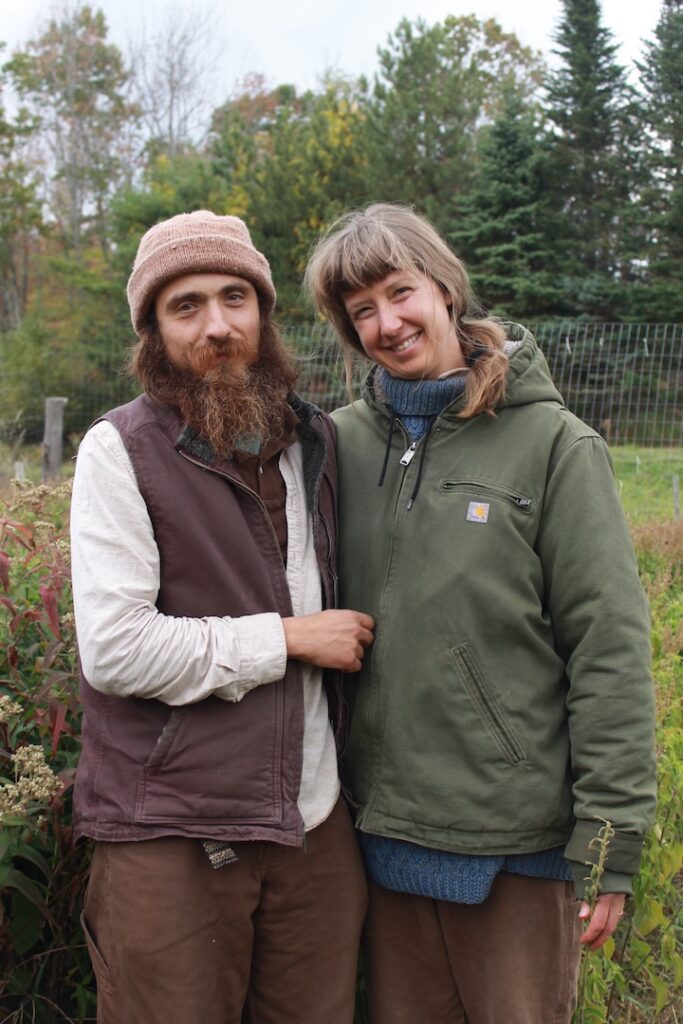
On three-quarters of an acre, the pair produces a stunning array of vegetables, pulses and grains, flowers, and culinary and medicinal herbs, all of which they grow seed to seed. The bulk of the varieties, including multiples of tomatoes, peppers, beans, and Tulsi basil, are grown for seed packet sales through their online catalog and a handful of local retailers in Maine and New Hampshire. Others, like a dime-sized, red-fruited cherry tomato called Florida Wild Everglades, are genetic reservoirs for breeding projects underway. Others still, like sweet-tart goldenberry, sesame, peanuts, and finger millet, are being trialed for viability in Maine’s unique, and often challenging, climate. Like squares of a quilt, each small patch and 100-foot field row tells a story. And like a family heirloom, passed down from generation to generation, the seeds grown here will move from hand to hand, and place to place, carrying the stories of Bhoomi Devi, as well as those growers who came before them and those who will come after.
A peek at their catalog, which combines well-researched seed descriptions and growing information with O’Dwyer’s gorgeous photography, shows crops with origins far and wide. Growers can purchase seeds of a heart-shaped tomatillo cultivated by the ancient Aztecs; or a summer squash resembling a trombone that is prized by Italian gardeners for its succulent flesh; or a hardy kale whose forebears clung to European sea cliffs. Each of these varieties, however, will also have roots, so to speak, in Maine soil.
Regional adaptation, says O’Dwyer, is “the key” to their crop plan. “We try not to do novelty for novelty’s sake,” says Dest. They won’t grow an all-black tomato, for example, just because it’s different; it needs to grow well in Maine, or be able to be selected to grow well, and it needs to be useful to the people who are going to plant it. “There’s this Indian melon that is orange- and green-striped and it’s gorgeous, and I would like to breed with it,” says Dest, “but I could not offer it as it stands right now, even though it looks cool, because it doesn’t taste good in this climate.”
O’Dwyer and Dest are not only growing and saving seed but in doing so they’re also consciously making selections for traits that they, and their customers, deem desirable. Gardeners and farmers have a hand in shaping their seed, they say. “ We tell people all the time: please reach out and tell us what you were successful with or what you struggled with because that informs us, what we look for,” says Dest. “Adapting plants has always been a community effort.”
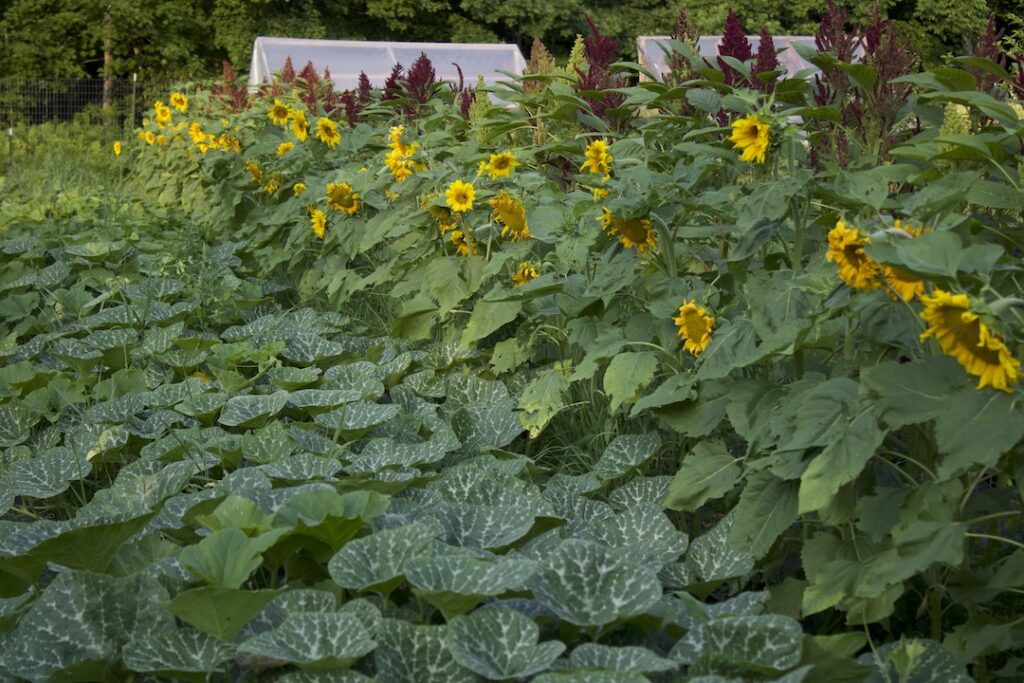
Starting from seedling emergence, the pair monitors individual plants for qualities like vigor and cull those that don’t measure up to their criteria. In the field, plants are assessed for tolerance to climatic conditions, like drought or prolonged periods of wetness, as well as disease and pest resistance. The ability of a plant to mature in their U.S. Department of Agriculture (USDA) Plant Hardiness Zone 5a field plot is a critical factor. As is flavor. Throughout the growing season, the two will flag individual plants they want to harvest seed from, using a system of colored string, to ensure that specific characteristics — from high yields to sweetness — will be passed along to the next generation. This means that the strains of Piracicaba multi-cut broccoli or Golden Giant amaranth produced at their farm will be genetically distinct from those produced anywhere else. This regional adaptation equates to resilience for their future seed crops and for the crops of the gardeners and farmers who purchase seed from Bhoomi Devi.
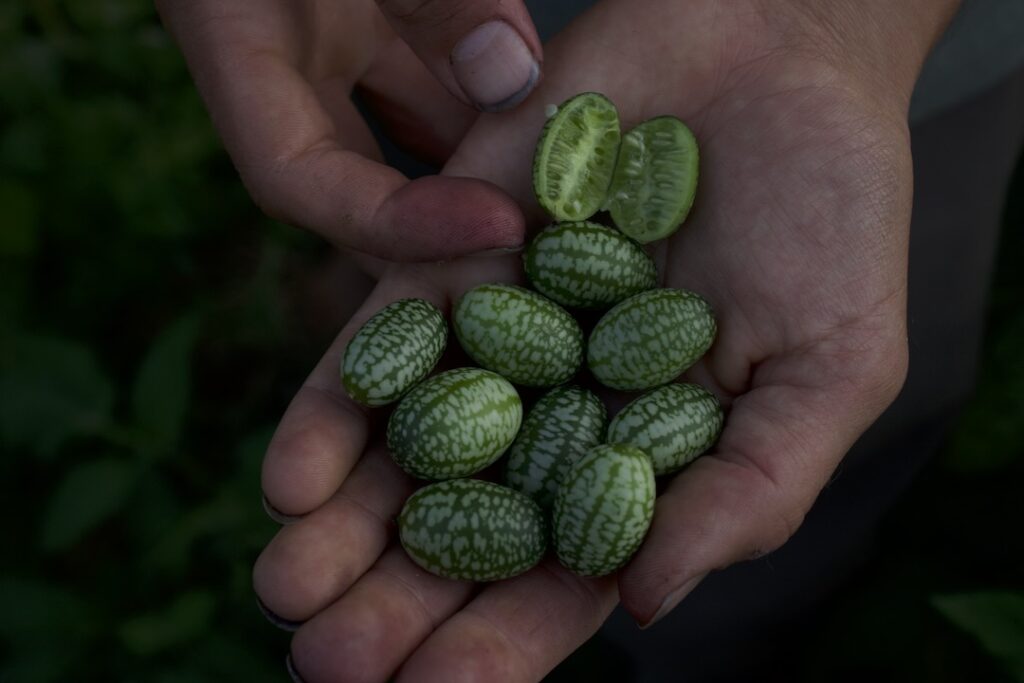
”We treat our plants very poorly and then we treat them good,” says Dest. In 2025, with severe drought affecting much of the state, they intentionally didn’t irrigate their crops. The goal was to see which plants thrived in those conditions and to save seed accordingly. “ Each year does present its own unique selection pressures, which is fantastic,” continues Dest.
He recalls one hot, dry season when only nine of their 100 Jimmy Nardello pepper plants produced a “reasonable amount” of fruit. Those were the plants they saved seed from. In 2023, which was cool and super wet, they were excited to see a couple of melons that produced really well. “That’s the bread and butter of our operation,” says Dest.
O’Dwyer and Dest are also selecting specifically for good performance under organic growing conditions. Certified by MOFGA, they don’t use inputs like chemical fertilizers — and even eschew pesticides approved for organic production. They pay particular attention to, say, any cucumber plants that are thriving despite cucumber beetle pressure. Bhoomi Devi wants their production approach to match that of their customers, many of whom are home gardeners who may not spray consistently or fertilize with gusto. Dest says, “ We really do try to withhold cultural practices that could be beneficial.” They then assess, evaluate, and select for tougher, more resilient strains under less-than-ideal conditions. When they lose a portion of their crop, they’re motivated to breed for resilience in the future.
Their growing practices were influenced by Will Bonsall of Khadighar Farm and the Scatterseed Project in Industry, Maine, where Dest volunteered during the 2016 growing season. A proponent of self-reliant systems, Bonsall uses materials like leaves, pasture grasses, and wood chips collected onsite as sources of home-grown fertility. Bhoomi Devi leans heavily on these materials, as well as cover crops, compost and compost teas, and wood ash, in an approach to growing that they call “hyper-local.”
Their farming practices are further grounded in an almost spiritual ethos. The Earth is viewed as a co-collaborator at Bhoomi Devi, which loosely translates to “Mother Nature” from Sanskrit. In selecting this as the name for their seed company, O’Dwyer and Dest pay homage to their connection to India — they first traveled there in 2016 and have returned several times since — while also acknowledging the intimate relationship between people and their environment. “It’s a collaborative effort,” says O’Dwyer. Dest describes seed saving as a mystical process, and she agrees. “ It’s not from start to finish,” says O’Dwyer. “It’s never ending.” Participating in the lifecycle of plants “really deepened that connection to all of these different beings,” she says.
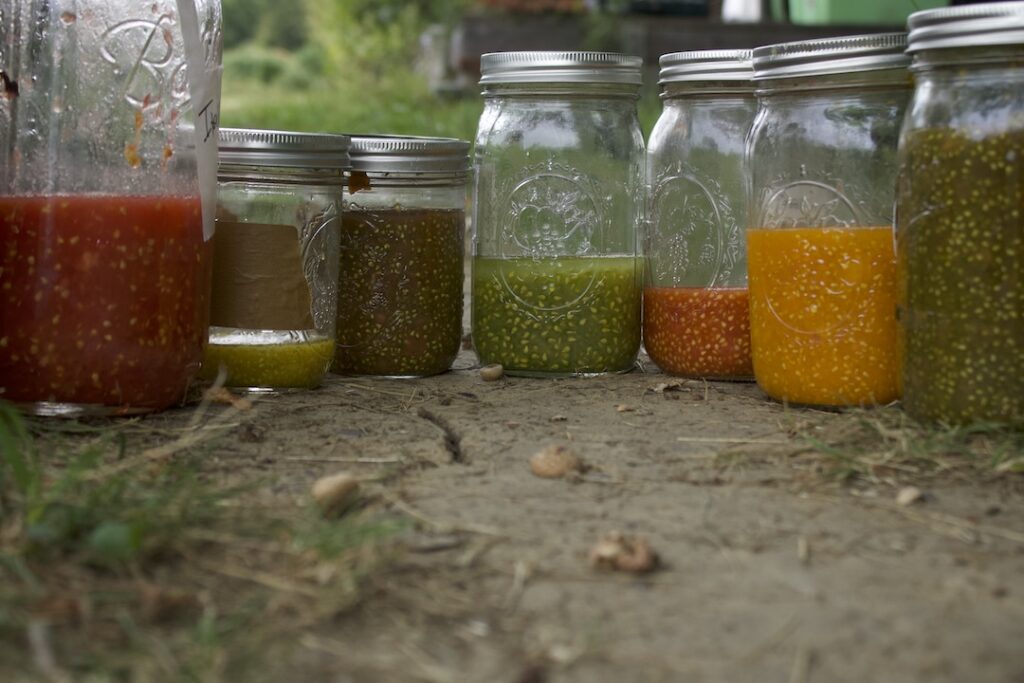
Dest and O’Dwyer, who met at a farm in New Hampshire in 2014, say they got into seed “organically.” Combined, they have logged 15 years on five different farms, but they didn’t initially set out to be commercial-scale seed growers. Bhoomi Devi began as an organic vegetable farm in 2019, with Dest and O’Dwyer cultivating a quarter acre on a terraced hillside in the White Mountains region. Inspired by Dest’s time with Bonsall, who once maintained a seed collection of several thousand varieties, they began saving seed alongside growing produce for market. They started small, dabbling with a few crops — including both annuals like tomatoes and lettuce, and kale, which is a biennial and needs to be overwintered to set seed — and were soon hooked. “You’re playing with the mechanics of creation in a way,” says Dest.
They moved their operation to Maine, where Dest grew up, in 2023, and have steadily increased their seed offerings, from their initial 25, over time. While they’re not maintaining nearly as many strains as Bonsall, their cultivation of 77 varieties across 42 species is no small feat and calls for meticulous observation in the field as well as careful planning throughout harvest, cleaning, storage, and sales.
To maintain genetic purity of the seed stock, many species of plants require some form of intervention to stop wind or insects from introducing pollen from another variety grown in close proximity. At Bhoomi Devi, they use a combination of strategies, including spacing plants an adequate distance apart — when possible. Even on three-quarters of an acre, this is easy to do with self-pollinating crops, like tomatoes, with 10-feet between varieties often being sufficient to maintain the genetic integrity of their seed lots, from Honeydrop to Black Opal cherry tomatoes. They give peppers, which Dest says have a 30% chance of crossing, a wider berth of several hundred feet. In some cases, they wrap cheesecloth around flower clusters to thwart any foraging insects that might transfer pollen between varieties.
However, cross-pollinating crops can require several hundred feet to several miles of separation, based on species. One option would be to grow only one variety of each “crosser” per season, but O’Dwyer and Dest have work-arounds to help them offer a wide array of varieties in their catalog. For example, they stagger plantings of different varieties of corn so that they won’t tassel at the same time. This ensures that their flour corns, such as Abenaki Rose and Byron, won’t pollinate each other. For other crops, including those in the Cucurbitaceae family (summer squash, zucchini, and winter squash), they turn to labor-intensive hand-pollination, spending three hours each day at the task. “ We’ll block off the flower before it opens — a male and a female — and in the morning time, open both up, pollinate the female, cover that back up, tie the string around to the corresponding key, and then we know that, at harvest time, anything that has a string around it is a hand-pollinated variety that we can offer true seed of,” says Dest.
Yet, sometimes they want things to cross. Over their years as seed stewards, Dest and O’Dwyer have gotten deeper into plant breeding. In addition to their selection work on existing varieties to adapt them to the Northeast, they are working on developing new resilient varieties. “There’s so many we’re really excited about,” says Dest.
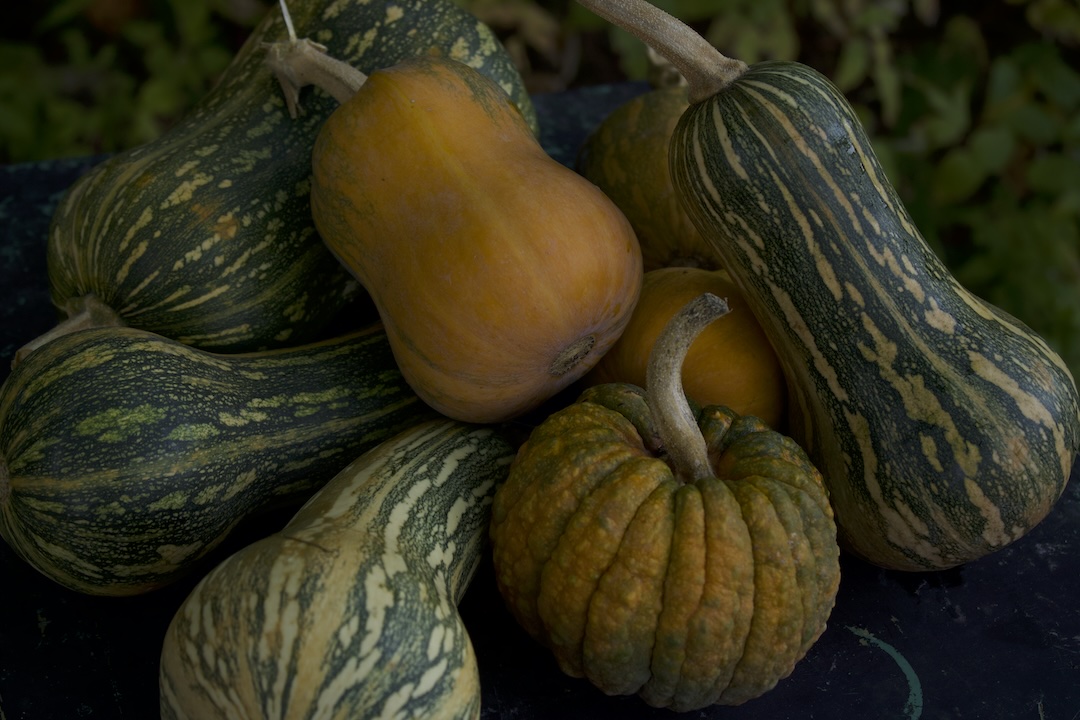
One such project is a cross between two winter squash species, Cucurbita maxima and Cucurbita moschata. Their hope is that the resulting cross, called an interspecific hybrid, will combine the sweet, dry flesh of the former (think buttercup and kabocha) with the latter’s resistance to squash vine borer — a pest that has become more widespread in the region over the past decade. C. moschata, the butternut species, also includes more tropical varieties from Southeast Asia as well as the Seminole pumpkin, says Dest. Along with pest resistance, they were looking for a parent with some resistance to downy and powdery mildews, as well as dryer flesh more akin to C. maxima. They ultimately chose to cross Honeynut and Tetsukabuto, two existing interspecific hybrids. In 2025, they harvested the F2 (second filial generation) of that cross. The fruit have mottled dark-green to tan skin, and range in shape from pear to classic pumpkin, but successive selections over the next few seasons will hopefully stabilize the traits they are prioritizing while achieving a more uniform look.
Another breeding project in the works is an overwintered kale that produces copious florets in the early spring. As seed producers, they dig up biennial Brassicas in the fall to overwinter in their root cellar, and then replant them the following season for seed. By selecting for plants that can survive Maine’s winter in the field, they’re streamlining the process. “ It’s like a twofold gift … which is one, as a seed saver, it just makes that work a bit easier, but it also then produces two crops for the homesteader or the farmer or gardener,” says O’Dwyer.
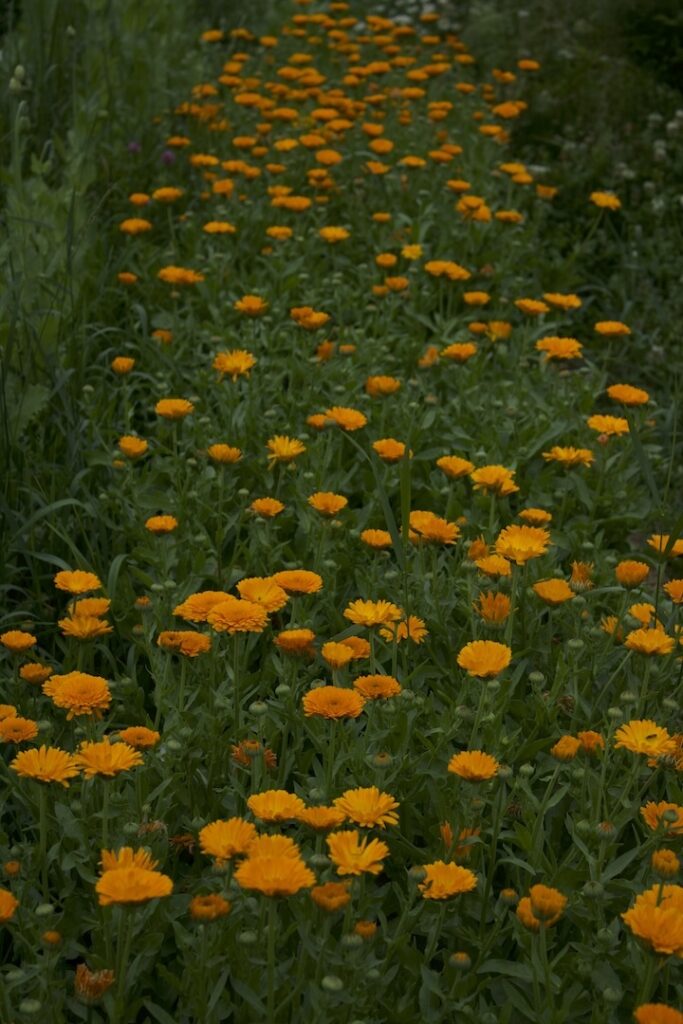
A walk through their 2025 plot reveals more projects in progress. Work on an overwintering fennel bulb appears as a towering clump of seed umbels reminiscent of dill heads. A patch of bright-orange, high-resin calendula blooms are being monitored for disease resistance by O’Dwyer, a budding herbalist. And their holy basil stands green and lush, despite a recent frost that would blacken less-resilient strains with the tell-tale signs of cold damage.
Each harvest is a manifestation of a particular season. It weaves together the strands of all of Bhoomi Devi’s prior work with that of other seed keepers — and the forces of Mother Nature. And with each harvest, O’Dwyer and Dest keep the future gardens of other Northeast growers in mind. In 2025, a corn crop didn’t yield well due to lack of water, aside from 10 lone ears. They, of course, harvested those as drought-tolerant seed stock. Dest says, “Every year is a win, I suppose.”
This article was originally published in the winter 2025-2026 issue of The Maine Organic Farmer & Gardener.