
By Maddie Eberly
Growing up in Pennsylvania, I found fascination in the forest while hiking through the rolling hills of Lancaster County. I observed shoreline plants while paddling on human-built lakes and on the Susquehanna River just a few miles south of Three Mile Island (a nuclear power plant that partially melted down in 1979), where the river had once been lined by factories and mills. While searching for my own purpose and meaning in life, I always ended up in the woods, and I fell deeply and irrevocably in love.
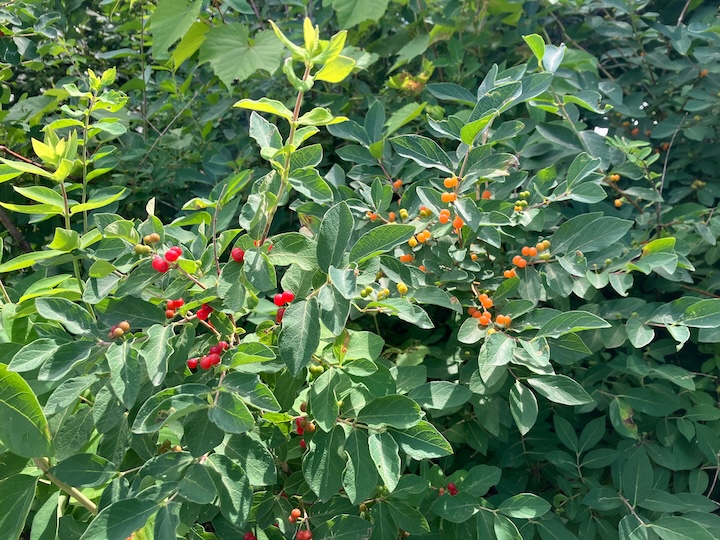
Years later, I returned to these same places of my childhood, but with a new lens shaped by my education in forestry and botany as well as seasons spent working as an invasive plant biologist. Suddenly some of those plants — golden-and-silver honeysuckle (Lonicera japonica), burning bush (Euonymus alatus), golden bamboo (Phyllostachys aurea) — that inspired my connection to the forest didn’t belong. Not only that, they were causing harm to the landscape. For example, I saw that golden-and-silver honeysuckle, a favorite treat of mine while out on hike or paddle, was shading out its plant neighbors with its dense growth habit. While searching for sunlight to produce food through photosynthesis, the vining honeysuckle may travel up a tree, wrapping around the trunk and branches, and may, in time, cut off water and nutrients flowing within the tree. I felt compelled to rip these plants from the soil.
However, it’s not a binary thing. Not much in the natural world is. To any question a forester is asked, the answer can almost always be, “Well, it depends.” It depends on the soil. It depends on the seed bank. It depends on the climate. It depends on the human relationship with the land. It depends on who is engaging with the land. Feeling uncertain? Me too. One of my chemistry professors once told me that all the things I was required to memorize for their specific course were waiting to be disproven, allowing a new reality to come forth. So, let’s take a moment and reconsider our forest plants.
Step into that patch of woods you love so much. Look around at the plants. Why are they on the landscape? Well, to answer that, we may need to go back 14,000 years to pockets of spruce refugia, places on the landscape free from ice during the last ice age that allow species to persist locally all these years later. Or, perhaps we only need to travel a few decades back when a loving gardener planted a delicious fruiting vine that reminds them of home. Either way, any plant is there because it holds (or held) a relationship to the ecology, to the landscape, to the people.
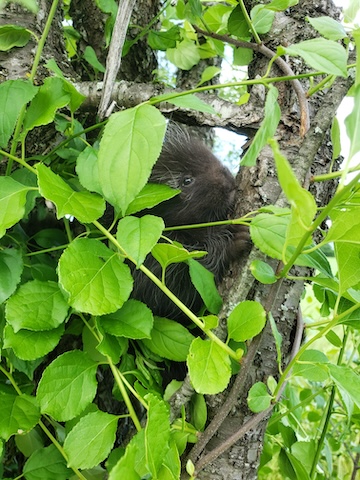
Our relationships with the land may shift. While wandering in Maine’s woods, old cellar holes can be found, along with the remnants of homestead gardens, including plants such as bittersweet vines (Celastrus orbiculatus), shrubby honeysuckles (Lonicera morrowii or L. maackii), various barberries (Berberis thunbergii or B. vulgaris), and burning bush (Euonymus alatus), among others. The garden remnants may be the primary plants on the local landscape — the person who left the plants behind didn’t consider that the land would once more become a wild space and that others might think those plants don’t belong there, or are even causing harm. Local wildlife or natural weather patterns may have further spread the plants introduced by the gardener through various transport pathways: consumed seeds later deposited; seeds temporarily stuck on fur; rain or waterways pushing plant materials further along; gusty winds catching small sails; and so on.
We, as a community, have collected evidence that introduced plants can cause harm to the natural function of the environments they’ve found themselves in. Plants that we become concerned with are typically ones that are exceptionally good at surviving and establishing themselves on a landscape once introduced. These plants usually produce large seedbanks that have multiple years of vitality. Some can reproduce through vegetative parts in addition to or instead of by seed. The plants often leaf out early and hang on to their leaves late, holding a sunlight advantage over plants that might leaf out later. Rigorous management by dedicated individuals can remove the introduced plants and their seedbanks from the landscape with time. And, often, this work is essential to pursue other goals of conservation, such as preserving a unique ecosystem, or transitioning from one forest type to another in favor of timber or wildlife needs, or to introduce nearby climate-resilient species through assisted migration. This work is important, especially in unique ecosystems with rare or endangered species present. Where people have changed the landscape, often our intervention will help transition the landscape to a semblance of its former condition faster than it could on its own.
As we consider our relationship with the landscape and our shared future, the framework for how we perceive plants and relate to them may shift. If we’re focused on growing and harvesting timber, the removal of introduced species can help to increase the number of successful trees that regenerate following a harvest. Or, if we are trying to strengthen the landscape’s climate resilience through assisted migration planting — taking tree species from nearby that are expected to do well and planting them further north — the removal of introduced plants is often the first step. The forest moves slowly, living a lifetime far longer than ours. We may never see the full realization of our actions on this land, but we must make the best decisions we can with the information and research at hand, finding motivation — and purpose — from the future the forest and humans both share.
Maddie Eberly is a forester and botanist working for MOFGA as their low-impact forestry specialist. Originally from Pennsylvania, they moved to Maine in 2017 to attend university and stayed for their love of the forest.