
By Tim King
Lineage is vitally important to Akilah Zuri Campbell of the Zuri Wingi Heritage Harvest Project in Lee, New Hampshire. The object of the project, she says, is to bring the crops and the agricultural wisdom of stories from the African Diaspora and Indigenous population to the region as it is today.
“My story begins with lineage,” says Campbell. “In the early 1900s, Mariah Hughes Carter, my great grandmother on my mother’s side, and George Washington Carter, my great grandfather, were able to save, over multiple years, enough to purchase 500 acres of some of the least fertile land in Chester, South Carolina.”
At the time, the economy of Chester, which is in northeastern South Carolina near the border with North Carolina, was built on steel making. However, the steel mill prosperity came to an end as a result of the Great Depression and the industry’s move overseas.
Campbell says, “My great grandparents would wind up selling 300 of the 500 acres in order to try to keep a portion of the land for their family, which included my grandmother and her seven siblings. That acreage allowed them to survive through farming.”
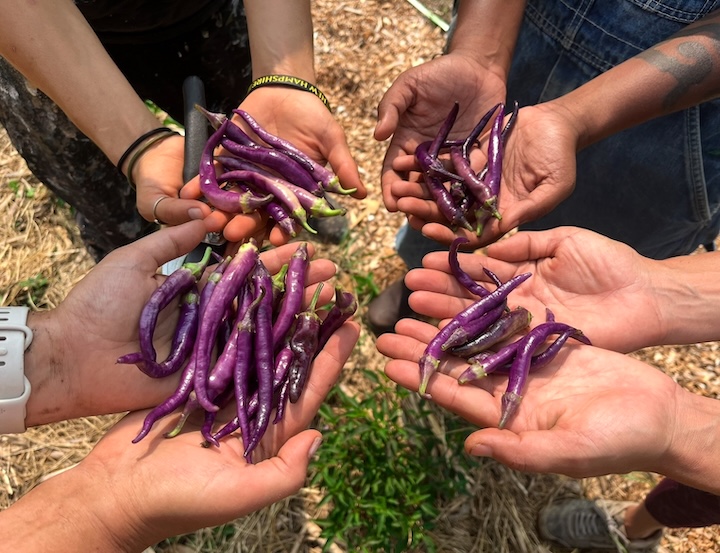
Through decades of regenerative crop and animal care the family was able to bring that depleted soil back to life. First Campbell’s great grandparents and then her grandmother and grandfather were nourished by that rejuvenated farm land.
“This land sustained them during very tough economic times,” Campbell says. “Financially, however, things didn’t work out. Being Black sharecroppers resulted in unfair pay for their harvest and livestock.”
Campbell’s grandparents, Emma and Martin Guinn Sr., decided to leave the social and economic discrimination of Chester in search of better opportunities. They migrated northward with millions of other Black Americans hoping to escape the horrors of the Jim Crow South and settled in Roselle, New Jersey, during what she describes as the second part of the Great Migration.
“Even though they only had an 8th grade education they both were able to find factory jobs,“ says Campbell. “My grandmother worked as a seamstress for a large company and my grandfather worked for American Cyanamid in the tannins production facility.”
Campbell’s grandparents, and many others who migrated to New Jersey with them, brought the wisdom gained through generations of being agriculturally self-sufficient. They also understood and practiced the joy and economic values of cooperation and mutual aid. That meant they knew how to grow and care for the food their families needed and they took it for granted that neighbors took care of neighbors who had fallen on hard times.
“Growing food took up most of their backyard space,” says Campbell. “Vegetables were grown using traditional practices that involved organic gardening along with companion plants and intercropping. Toxic chemicals were a complete ‘no go’ and no one on the block and in the surrounding community ever went without nourishing sustenance because of these gardens.”
Campbell’s parents, Stanley Campbell Jr. II and Deborah Guinn Campbell, grew up in an economy of abundance and generosity and named their daughter Akilah, which means “intelligent and logic” in Swahili. Her middle name, Zuri, means “beautiful.” The child, Akilah Zuri, was deeply moved as she grew into this culture her family carried with them to the New Jersey suburbs.
“I fondly remember helping my grandmother with planting, caring for, and harvesting vegetables during three of the four seasons,” Campbell recalls. “Then I helped my grandfather to prepare the green beans, collard greens, and squashes while sitting with him at a table on the front porch. I took these lessons in land and community care with me throughout college and into adulthood.”
After attending college in New Hampshire, and earning degrees in wildlife management, ecology, and education, Campbell decided to put down roots in the sea coast area of the state. She spent the next decade teaching a range of subjects to middle and high school students, as well as adults.
“I loved teaching my students through project-based learning, when possible, by using gardening and farming to introduce them to science and to the STEAM subjects of Science, Technology, Engineering, Art, and Math,” she says.
In addition to teaching public school students during those early post-college years she learned that community gardens carried a culture with some of the same values and practices she experienced as a child. She also discovered the teaching and educational potential of those communal spaces.
To that end, she became a member of the Wagon Hill Farm Community Garden, in Durham, New Hampshire, where she was the education and community outreach coordinator, a board member, and also a food pantry volunteer.
“Community gardens are so very important to building a sense of belonging and connection,” Campbell says. “I have seen how being part of a community garden can help people heal from current or past traumas, and I’ve seen people find or rediscover their connection with the land. That’s something that many have lost because of busy work schedules and some of life’s other obligations.”
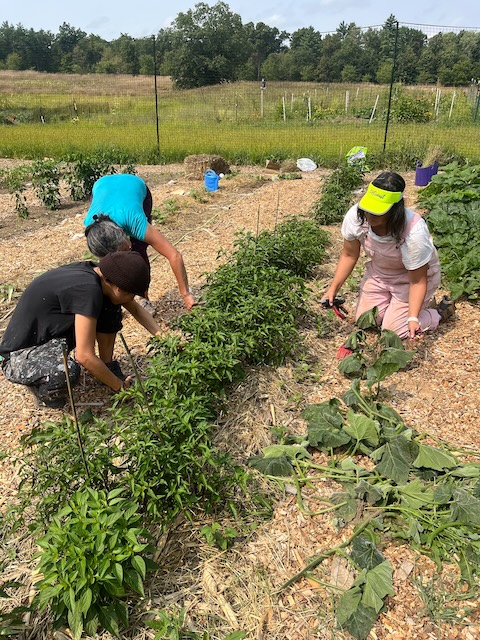
Community gardens can also be healing spaces for children, she discovered. “It’s a space for them to explore and be themselves,” she says. “That’s something that I found was often missing in their lives when I taught middle and high schoolers who lived more in inner-city-like settings.”
While Campbell was teaching public school students and community garden members, she was also tending her own garden using much of the wisdom that had been passed to her by her grandparents and parents. Eventually, the teaching, the community work, and the wisdom of her ancestors all came together as Zuri Wingi Heritage Harvest Project. In naming the project Campbell honored her lineage by using the name her parents bestowed on her, Zuri. In honor of all those New Jersey backyard gardeners who came up from South Carolina she also named it Wingi, which means “abundance.” Beautiful Abundance.
On the surface Zuri Wingi Heritage Harvest Project is a garden at MOFGA-certified Tuckaway Farm in Lee, Hew Hampshire. In the garden is a beautiful abundance of joyous diversity that includes crops from the gardens from her childhood.
Campbell ticks off some of the vegetable varieties in her quarter-acre garden: green beans; zucchini, the kusa squash variety; Alabama Blue collard greens; tomatoes including Aunt Lou’s Underground Railroad, Plate de Haiti, and Sierra Leone Ribbed; Catawba Freeman okra; Sea Island Red okra; Green Striped Cushaw winter squash; Jamaican pumpkin; and Ezelle Family Fish Eye black-eyed pea.
Seeds, and vegetable varieties, have lineage, just like humans — and with lineage comes stories. Take the Ezelle Family Fish Eye black-eyed pea as an example, which Campbell got from True Love Seeds in Philadelphia, Pennsylvania. She says, “The Ezelle family is originally descended from Mali, West Africa. They were first enslaved on a plantation in Hahnville Parish, Louisiana, from 1820-1860s. They were later split up and some were relocated to Chickasaw County, Mississippi. Kris Hubbard received these seeds in the 1990s from an old-timer in his 80s, named Ezelle, who had married a Choctaw woman Kris knew. Mr. Ezelle said his grandmother had carried the pea from Louisiana by placing a few into a wilted leaf tucked under her hair. His mother, who called the pea ‘Fish Eye,’ cared for them until he had his own garden.”
Campbell is also growing Sea Island Red okra, and saving its seed. Sea Island Red, which she obtained from True Love Seeds, too, is not like the okra variety that her grandparents, Emma and Martin, brought to New Jersey from South Carolina. Okra does, however, have cultural significance to Campbell’s family and, more broadly, the people of the African Diaspora.
“My grandparents understood not only okra’s cultural significance but also its health and medicinal properties,” she says. “They would not only cook okra but would also boil it to make okra water. They said okra water was good for digestion. It turns out that it really is good for the digestive system’s microbiome and it can help to reduce cholesterol, too.
The medicinal properties of plants are an important part of the wisdom that Campbell wants to share through Zuri Wingi Heritage Harvest Project. “My great grandmother, Grandma Heldley, who was Black and Native American, was well aware of the medicinal properties of okra since this knowledge was passed down through generations,” says Campbell. “She knew how to make herbal tinctures and teas for health. I’ve shared one of them, white pine tea, with my students and friends.”
Students and groups of all sizes come to the garden at Tuckaway Farm. On one afternoon, Campbell gave several families with younger children garden tours and shared some seedlings with them. She also gives more structured workshops during the farm’s community volunteer days.
“This allows community members to have real-time hands-on experience while also helping out and making connections,” says Campbell. “I show seed saving in the field when possible. For example, I show how to save the seeds from Ethiopian Green Mustard seed pods that have already dried, as well as okra.”
In addition to discussions about seed saving, workshops might also include how to identify pests, such as squash bugs and beetles, and how to organically remedy the situation through companion planting, intercropping, or the use of neem oil.
Campbell has also made presentations about her work at winter gardening and farming conferences.
The garden is the beating heart of Zuri Wingi Heritage Harvest Project but Campbell is beginning to imagine using the garden as a cultural springboard. On occasion, lessons and conversations in the garden will be followed by a community potluck meal and a presentation.
“A recent workshop brought a speaker in to help participating community members imagine, and start to create, a solidarity economy,” says Campbell.
Following the meal and introductions, workshop participants were asked to reflect on their own and their family’s connection to the land. They were then asked to imagine how they could create more connection. Following that, the workshop facilitator asked people what their concerns were, especially pertaining to the near future.
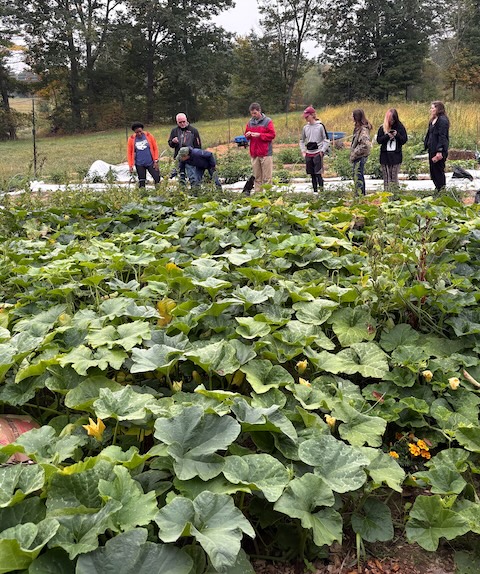
“Many who attended were concerned about having a safety net for not only themselves but for other community members,” says Campbell. “They wondered how can we support those in need of basic necessities, those in need of an ally, those in need of sustenance, or those in need of mental health support. Through these conversations we were able to make new connections with each other and gather lists of important resources.”
One of those resources is, of course, the Zuri Wingi Heritage Harvest Project. The project includes not only the garden lessons and workshops but is a hub of sorts, connecting to other resources. One of them is Campbell’s commitment to giving a quarter of the bounty from the garden to food pantries or those in need.
“I think it is important for us to try to have an abundance mindset, as mainstream media seems to try to paint a picture of every person having to fend for themselves,” she says. “In truth, the way that many communities, especially Black and Indigenous communities, made it through difficult times was by working together, sharing their resources, and caring for each other. What is now known as an alternative economy, or solidarity economy, always existed and was much more common in the past.”
An abundance of care for the Earth and for each other provides more than enough for each of us. That was the experience of Campbell’s relatives, and she imagines recreating it through Zuri Wingi Heritage Harvest Project and the wisdom of her ancestors.
Tim King is a produce and sheep farmer, a journalist, and cofounder of a bilingual community newspaper. He lives near Long Prairie, Minnesota.
This article was originally published in the winter 2025-2026 issue of The Maine Organic Farmer & Gardener.