
By Sam(antha) Burns
During lambing season, I wake every two hours to check the lamb-cams for “activity,” anxiously watching for signs of labor or newborn lambs. Video cameras and Wi-Fi extenders are two of the best investments I’ve made in shepherding, but really the most valuable asset has been the accruing knowledge that only comes from experience.
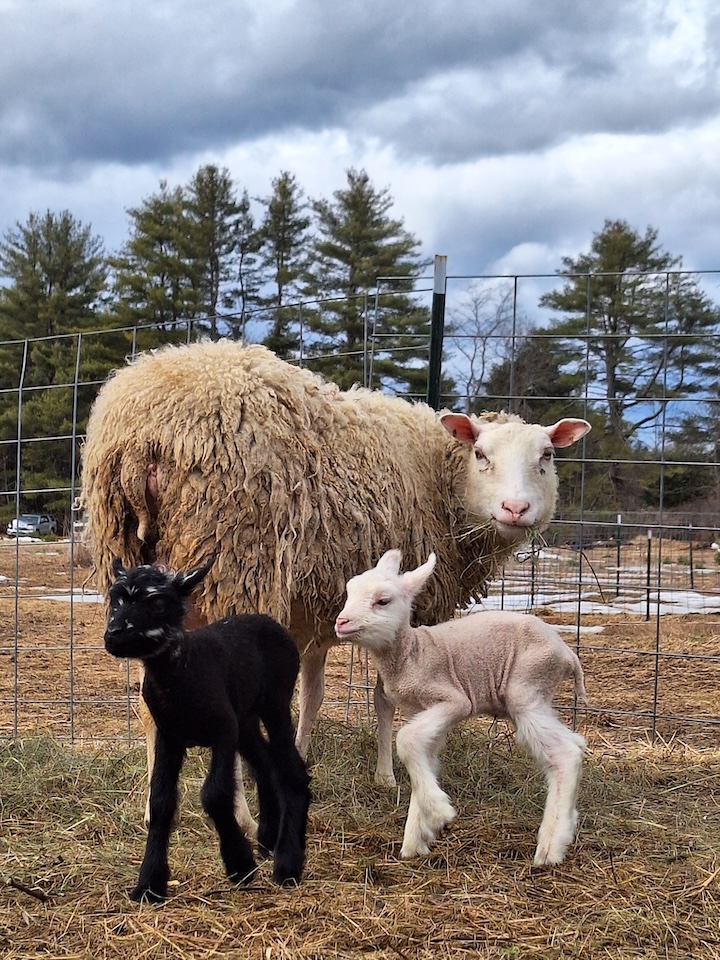
Finnsheep at Runamuk Acres Conservation Farm. Sam(antha) Burns photo
For the last seven years, I’ve kept a small flock at the Runamuk Acres Conservation Farm in New Portland, Maine. Sheep play an integral role in helping us regenerate soils and promote habitat, as we employ rotational grazing to aid our efforts in wildlife conservation.
One night in early March, scanning the lamb-cam screen, I counted heads and woolly bodies in the black-and-white picture. Seeing the tiny white figure bobbing around, my pulse quickened and I threw back the covers — there would be no more sleeping this night!
In pajamas and a hoodie, I made my way through the darkened farmhouse to collect my “lambing bin.” I always keep it ready with essential items like clean towels, a bulb syringe, iodine, a fast-acting supplement that boosts energy and immune systems, and a first-aid kit. Then, slipping my feet into a pair of muck boots, I went out into the night.
Nearly 20%of lambs die before weaning, with 80% of those losses occurring during the first 10 days of life. March in Maine might offer some warmer days, but nighttime temperatures were still bitterly cold. In most cases, intervention is not necessary — the ewe will clean the lamb and the newborn will find its way to the teat for that crucial first feeding. For those who struggle, however, I like to be on hand, and once lambing begins, I tend to sequester myself at Runamuk for a period of 10 to 14 days.
I could hear the newborn crying as I approached, and warmth flooded my chest. Every lamb born to this farm is a precious gift.
Letting myself into the sheep-shed, I found a darling snow-white lamb, already cleaned and bobbing around as the ewe, Wendy, tenderly crooned to her baby.
“What a good job you did!” I gushed, tears slipping down my cheeks.
Picking up the still-damp lamb, I fished in the lambing bin for the iodine and spritzed the umbilical cord before coaxing Wendy into a pen at the back of the shed and placing the baby at her feet. Together, they would spend the next 24 to 48 hours isolated from the rest of the flock as they bonded.
As the ewe’s sides contracted, I could tell another baby was on its way, and she turned to paw at the fresh straw.
Turning on a lantern hanging from the rafters above, I set about inspecting the other ewes. I had seven expecting mothers this year.
As their due date approaches, a sheep’s udder fills with milk and their vulva becomes soft and swollen. The hips become more prominent as ligaments loosen for birthing, and evident mucous means baby is imminent.
Finding tiny white toes peeping from Helen’s vulva, I ushered her into the second lambing pen. A champion mom named after my late aunt, this was Helen’s fourth pregnancy. I watched as she gave birth to a striking black-and-white ram with badger markings on his face.
Over the next half hour Wendy produced a second pure-white baby ewe, every bit as robust as the first, followed immediately by a tiny black ram lamb. Seemingly oblivious to the black lamb, the ewe turned in the pen, kicking litter onto the still wet and unmoving mass.
It wasn’t the first time I’d seen a ewe ignore a runty lamb and I sprang into action. Taking a towel and bulb syringe from the bin, I squeezed into a corner of the lambing pen. Working quickly, I suctioned the mucous from his nostrils and rubbed the runt with the towel, drawing his first cries of life. He instinctively lurched to his feet.
Small though he was, the runt moved in search of a teat, but Wendy whirled and head-butted him forcefully. The tiny black lamb stumbled backward, bleating pitifully as the ewe turned back to her white twins.
My heart sank. I’d seen this before. Finnsheep, a Finnish sheep breed, can have four, five, even six lambs per pregnancy, allowing the shepherd to rapidly grow their flock. But it comes at a cost. Ewes will often reject runty lambs to ensure the survival of the stronger ones. In the wild, this might be nature’s harsh calculus, but at Runamuk every lamb matters.
Scooping up the shivering runt, I held him close, feeling his rapid heartbeat. I could wait and see if Wendy would come around, but in my experience waiting rarely paid off. I could bottle-feed him, but bottle-babies come with their own challenges.
Crying from the adjacent pen told me Helen had delivered her first lamb, and as I listened to her crooning, I decided to try something drastic.
“Come on, little one,” I murmured.
Helen had a proven track record, but would she accept another ewe’s lamb?
The timing couldn’t have been more perfect. Just as Helen laid down to push out baby number two, I placed the runty lamb in her pen, smearing some of her amniotic fluid onto him. I held my breath as both babies began to cry. When Helen stood to start cleaning her baby, she immediately accepted not only her own lamb, but Wendy’s runt as well.
The little ram lamb wobbled toward her udder. Helen shifted her stance and within moments he was nursing alongside his adopted sister.
I exhaled slowly. It worked! True to her namesake’s generous spirit, Helen had accepted the orphan.
Over the following days, I monitored the little family closely. Helen proved devoted to her adopted lamb, and the runt began to gain weight and strength. By week’s end, you’d never know he’d been rejected — he bounced around with the same vigor as all the other lambs.
Wendy’s twins thrived as well. Perhaps she’d known all along that she couldn’t adequately care for three. Either way, the outcome had been good for all.
By the time the last ewe delivered on day 12, I was exhausted but exhilarated. Seventeen lambs had been born, and fifteen were thriving. One had been still-born, and the other succumbed to night-time temperatures before I could get to it.
Standing in the morning sun, I watched the lambs testing their legs as they zoomed back and forth, leaping and making funny kicks. The black ram lamb, now strong and growing, caught sight of me and trotted over to investigate my boots.
I knelt down and ran my hand over his velvety wool. “You’re a fighter,” I told him.
Lambing season at the Runamuk Acres Conservation Farm is an intense time, but within a few short months these little ones would be half-grown and on the field with the rest of the flock. I savored the baby-phase knowing there would be days ahead when the work of moving fences and hauling hay would test this farmer’s strength and dedication. Committing the moment to memory, I gave silent thanks for these animals and this scrappy patch of Earth. It’s a privilege to live such a farmish life, and not one I will ever take for granted.
Sam(antha) Burns is a writer and farmer at the Runamuk Acres Conservation Farm in New Portland, Maine. Her work can be found online at: runamukacres.substack.com.
This article was originally published in the winter 2025-2026 issue of The Maine Organic Farmer & Gardener.