
By Jacki Martinez Perkins
“She’s beautiful, she’s rich, she’s got huge … tracts o’ land!”
– King of Swamp Castle in “Monty Python and the Holy Grail”
We do not need huge tracts of land in order to keep livestock. Industry professionals like to use general guidelines of 1 acre per animal, but this is, well … general. If someone is truly dedicated to good pasture management (and not just looking for excuses to hoard animals) acreage doesn’t matter; management is key and winter time is a wonderful time to plan for springtime pastures. There’s even still the opportunity to utilize some restorative practices for those that already have critters.
Ensure Diverse Diets
Consider ways to keep your livestock’s diets as diverse as possible. Digestion happens by feeding a population of specialized gut bacteria, and the absorption of those well-fed bacteria is what fuels the body. The gut microbiome requires roughly two weeks to repopulate specific varieties of microbes in order to reach peak feed efficiency. In order to keep our animals from essentially starving during seasonal or weather-related changes, we as managers should always plan to maintain as large a variety of gut microbes as possible. This may look like feeding a bit of hay all year, or keeping a small plot aside that is irrigatable in order to supplement their diet by bringing them fresh feed. The idea is to maintain a small population of gut bacteria that can then flourish once conditions change. Without this diversity in feedstuffs, changes to the diet need to be made over a minimum of two weeks in order to avoid shocking the systems of our animals.
Maximize Forage Health
Always plan to guard the health of your forages. Over-grazing of desired species is the number one blunder of anyone with herbivores. To avoid this, plan your grazing and rotating plan with a high-use area that is reasonably well-drained and easy to clean droppings from. This is where animals will be sequestered until the forage is ready. They will need to be fed supplemental feed while in this space; do not rely on whatever weedy, potentially toxic plant species may be present. Animals will likely still nibble these but with access to enough quality feed to keep them properly satiated, they are unlikely to ingest dangerous amounts (with the exception of some highly toxic plants that each steward should be aware of before managing their specific animal species).
Allow for Forage Regeneration
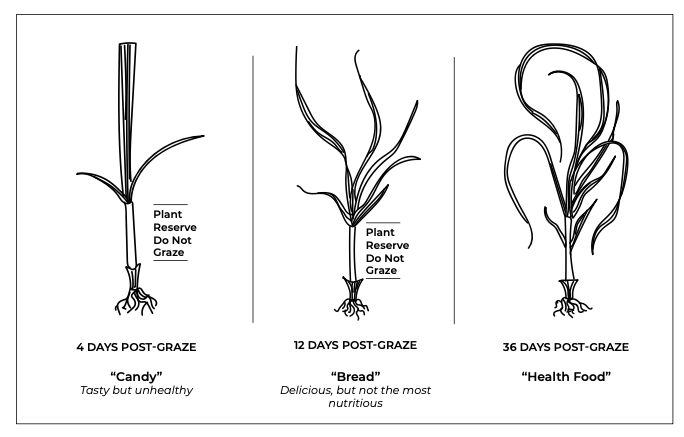
Now, if we want the available forage to be healthy and able to regrow, we must give it time to do so. Browsing animals, like goats and sometimes horses, can be allowed to eat young shoots of woody species but should be moved off quickly to allow the plants time to regenerate. This then adjusts the 21 to 45 day “general rule” set forth for creating pasture rotations. The same can be said of sward density (the amount of plants per square foot) and actual grass species in more traditional grazing systems. If the ground is suffering a case of balding, where we can see bare dirt between our forages, do graze the animals on it, but don’t leave them there for long. I say this because there’s an incredible diversity of viable seeds in our soils ready to respond to conditions topside and being grazed, then pooped on, is part of the stimulus they’re seeking.
Add Organic Matter
If you lack organic matter in your soils, one of my favorite wintertime strategies is what is called bale grazing, where we feed more hay than the animals will consume out on the pasture area, in a grid-like pattern. We should approach this the same way we would graze, by moving animals to a new section before paddocks turn into an aerobic quagmire; then we would need huge tracts of land! I suggest using late-harvested hay for this strategy, since it usually has a higher seed content than other seasonal cuttings.
Boost Fertility
Lastly, you’re going to have manure, so spread it! I’ve been having great luck putting my compost out on my 2 acres, both spring and fall. I don’t have enough to do all the acreage, so I make sure to pay attention during the growing season and target the areas that need it most. Even though I have a bucket tractor, sometimes ground conditions mean that I can only get out with a wheelbarrow — but that means I don’t have to pay for the gym. This is another reason why I love pocket-sized pastures: they feel manageable in my busy life.
As MOFGA’s organic dairy and livestock specialist, Jacki Martinez Perkins brings the knowledge she has gained from her upbringing, education, and her experiences abroad, to bear on the unique challenges that face Maine’s dairy and livestock producers.
This article was originally published in the winter 2025-2026 issue of The Maine Organic Farmer & Gardener.