
By Meg Mitchell
The Maine Mobile Health Program works across the state to provide equitable healthcare to underserved populations, including farmworkers and rural communities. While they’ve been in operation for 39 years, their work is growing more necessary due to the overlap of climate change, agriculture, and healthcare. As an agricultural service provider with MOFGA, and a recent addition to MMHP’s board of directors, I’m inspired by their strategies, impact, and visions for the future.
Amelia Rukema, MMHP’s chief executive officer, says, “Our services are all encompassing. We help with anything that comes up at our mobile clinics. Primary care and behavioral health, and then our community health workers are there to support any of the other needs in accessing referrals or follow up.”
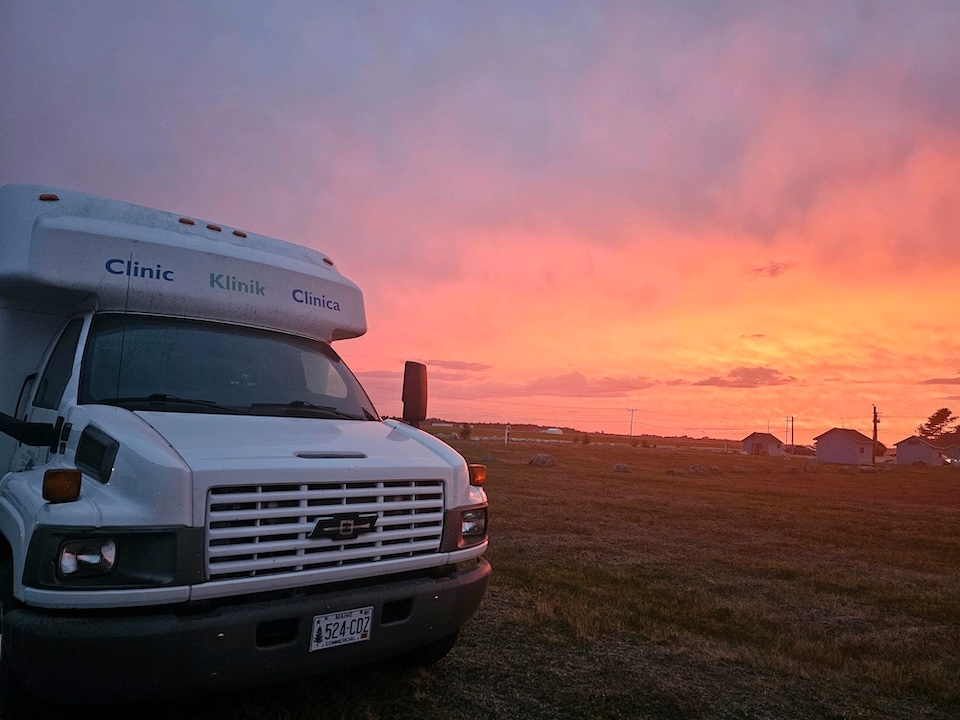
Mobility is a key part of their ability to provide this level of care throughout the state. The organization’s website states: “To maximize access, our mobile units and community health workers travel throughout the state to support workers in the blueberry, apple, egg, Christmas tree/wreath, tree-planting, and broccoli harvests. We also support workers living in Maine year-round who are employed in dairy, blueberries, aquaculture, and seafood processing.”
Rukema says, “The people we serve are all community members. The folks who are harvesting our fruits and vegetables are residents of the area, members of our local community. Our children are in school together. It is foundational to understand that we are all in this together as a community. The healthier farmworkers are, the more fruits and vegetables will be harvested, the healthier our communities will be. That cycle is so clear in how this is all for our collective health and not only for one particular population.”
Clinical coordinator Harden Wisebram says MMHP adapts their services to meet the specific needs of the populations they serve. She notes that one of the amazing things about the clinics that they run is that they are often in people’s preferred languages. She adds, “When you go see another healthcare provider, those basics are not guaranteed.” MMHP has community health workers transport patients to their appointments and also provide interpretation during the appointments. “Those patients are often familiar with the community health worker in their area and have a trusting relationship with them,” says Wisebram.
For Laura Valencia Orozco, MMHP’s behavioral health director, offering behavioral health care means having humility and centering listening as a core element of building trust with her patients. She always has candy, tea, coffee, or something that may represent home available. She says, “It’s really about listening to what is important to the people that I’m sitting with, the communities that I’m sitting with. There’s so much stigma around mental health. There’s so many barriers to wanting to talk about it. Some of the things that I’ve learned is that instead of talking about the mental health symptoms, we think about ‘What are the things that are bringing you here and what is really important to you?’”
Valencia Orozco also says that talking about food, music, gardening, or other day-to-day activities can give a peek into patients’ lives, an idea about where they are coming from, and what experiences they are showing up with. She adds that it is crucial for MMHP’s behavioral health workers to be tuned into what is happening in their patients’ countries of origin that may also be contributing to mental health struggles.
Climate change plays a role in the daily stressors of MMHP’s patient population. Rukema says that while big climate events in Maine are few and far between, their patients may have loved ones experiencing climate catastrophes. Another big factor for farmworkers is the reliability of the harvest. A more uncertain climate means less secure work. Valencia Orozco says workers are often asking themselves, “How long will I actually have work? Will I have work tomorrow? How is this going to impact my income?” She adds, “People really rely on the income from that harvest and it’s so unpredictable, so that really impacts their mental health.”
MMHP has built out programming to manage heat stress recently, to address the shifting summer heat conditions for farmworkers. Another priority that they started providing comprehensive education for is asthma. Rukema says that some of their patients have asthma, and Maine’s air quality is a result of being “the tailpipe of the nation.” MMHP has been able to pivot their services to meet the needs of the communities they serve, solidly standing behind their model of patient-driven care.
As any organization does, MMHP struggles with staffing, funding, and providing wages that keep up with the rising cost-of-living. They are maintaining a fleet of mechanically complex mobile health units, which are basically doctor’s offices on wheels, and have found themselves operating as ad hoc vehicle mechanics who must constantly learn new skills in order to adapt to the changing social and economic climate. Along with these road blocks, Rukema says that changes at the federal level impact the work that they do. “There are implications of folks feeling less comfortable accessing services and having more fear around doing so. This is something that our program does so beautifully, it builds those connections individually with folks one-on-one so that even when there are questions or concerns, they know who to go to and they have that relationship established and they feel safe to ask those questions.”
MHHP’s staff is committed to their approach, echoing each other with shared sentiments around “this is the way healthcare should be.” Wisebram says, “I have had a couple of different jobs as a nurse but always kind of felt like I wasn’t able to be a part of a system that I truly thought got it right or could truly believe in. The care that the Maine Mobile Health Program wants to provide, to me, is the ideal of healthcare and what it should be like.”
Rukema says the care they provide is centered on dignity. “At one of our clinics recently where we were working with some folks who had experienced homelessness, one of the patients said, ‘This is the best I’ve ever been treated by a doctor before. I’ve never been treated with so much dignity.’ That’s the way it should be. That’s the way we should feel when we’re working with people who are caring for our bodies and our minds.”
Valencia Orozco’s vision for an equitable future is one “where services would be accessible to everybody regardless of language, regardless of needs, regardless of how you’re showing up at a health center or at a social service organization or the community organization.”
In Rukema’s vision, everyone has the same opportunity for optimal health — regardless of availability, location, and other factors. “Healthier farmworkers, who have less injuries, have less disease, who are living their best healthy lives, I think would be such a gift for all of our communities.”
As the Maine Mobile Health Program evolves to meet the moment, the wider community is invited to get involved with the cause. They are always looking for more doctors, nurses, and behavioral health support to join the team, and staff has invited the public to get in touch directly to find out how they can fit into the mission, whether by donating, participating in toiletry and clothing drives, or volunteering at a MMHP event.
Rukema says, “We should be seeing farm work as an important role in society and giving this job the respect that it deserves. We should be seeing our farmworkers as heroes because that is what they are. They’re feeding our communities.”
This article was originally published in the winter 2025-2026 issue of The Maine Organic Farmer & Gardener.