
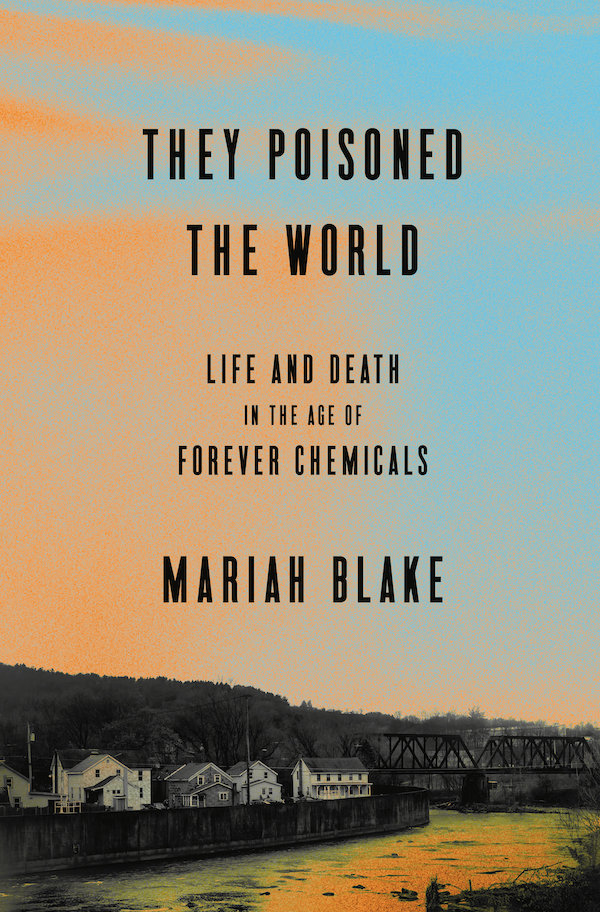
By Mariah Blake
Crown, 2025
“Forever chemicals” is the nickname given to per- and polyfluoroalkyl substances (PFAS for short) because they do not break down in nature. Originally created for military applications, these chemicals make non-stick pans possible and are found in stain-resistant carpets, water-repellant raingear, firefighting foam, plastic water bottles and baby bottles, cosmetics, and fast-food containers.
PFAS are now ubiquitous in the environment, and are found in plants and animals around the world, including “the bodies of virtually every person on the planet,” writes Mariah Blake in her new book, “They Poisoned the World.” Linked to cancers, obesity, and neurological problems, PFAS are in our drinking water and in our blood.
But 10 years ago, people were just beginning to find out how dangerous these chemicals could be. That is where Blake begins her story: with an unassuming insurance underwriter in Hoosick Falls, New York, who wondered whether something in the town’s drinking water contributed to his father’s cancers.
Seeking a photo for his father’s wake, Michael Hickey climbed into his parent’s attic. It was crammed with plastic barrels that his father had brought home from the Teflon factory — barrels then packed with winter clothes, Christmas decorations, and, Hickey hoped, family photos. As he searched, he noticed a faded label warning of “toxic gases.”
Hickey remembered stories of local friends and family members who had also died at an early age from cancer. Did something from the Teflon factory get into the wells that supplied the town’s drinking water? Hickey tested his tap water. The results showed dangerous levels of PFAS.
Blake follows the history — and the money — all the way back to the 1800s when a young member of the DuPont family gained a munitions contract from President Jefferson. Since then, DuPont has been involved in military contracts for the production of everything from smokeless gunpowder to synthetic materials. — some used for space exploration. The secrecy around the production and use of PFAS stemmed from DuPont’s involvement in the Manhattan Project; the chemicals were a necessary part of developing an atomic bomb.
One of the things I like about this book is how the author weaves back and forth between the Hoosick Falls story and the history of modern plastics. She shows how companies like 3M turned wartime inventions into peacetime profits. Poison gases, she writes, found new life as pesticides. Explosives were repurposed as fertilizers. And plastics found new uses as Tupperware, grocery bags, shower curtains, and more.
By the 1950s, though, scientists were linking a number of these chemicals and cancer. The chemical companies producing these products knew about the problems, Blake notes, but covered up their research.
Congress eventually passed food safety laws that included residues from packaging, but industry lobbyists weakened the laws to grandfather in thousands of substances already in use as “presumed safe,” including Teflon and PFOA (perfluorooctanoic acid), one of the forever chemicals.
By turns, this book provokes outrage and inspires hope. It is well-researched, with information gleaned from more than 600 interviews and hundreds of scientific papers — reflected in the 50 pages of notes at the back.
– Sue Smith-Heavenrich
This review was originally published in the winter 2025-2026 issue of The Maine Organic Farmer & Gardener.