
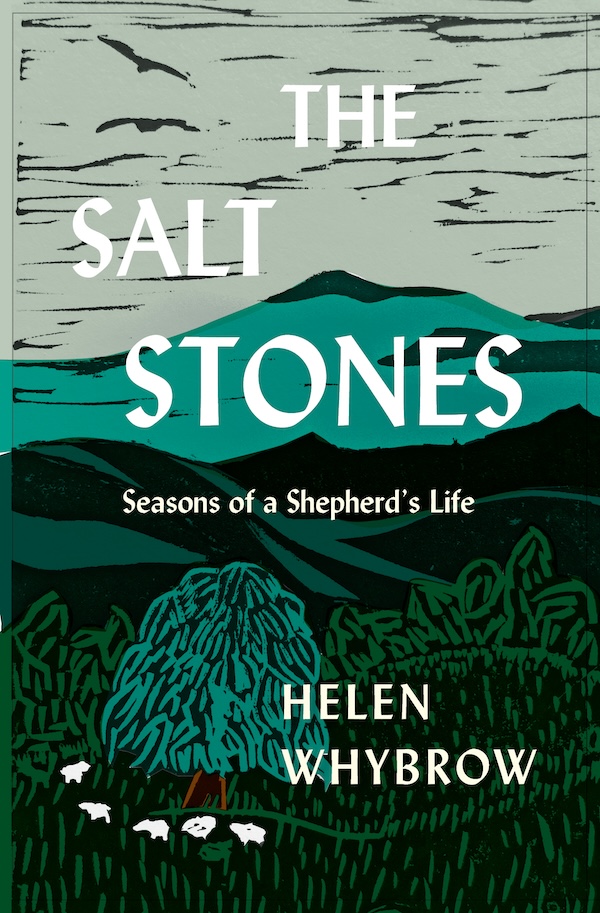
By Helen Whybrow
Milkweed Editions, 2025
“The Salt Stones” begins with an initiation: A ewe gives birth to two lambs. One lives. One dies. Helen Whybrow, the shepherd and author of this book, knows she will have to tell her toddler, Wren, about the death, and that they will go see the living and dead lambs together. With that, Whybrow steps forward into the story of her shepherding life, bringing the reader along with an ever-present tension of birth and death.
Following the arc of her life, “The Salt Stones” begins with Whybrow’s own childhood and quickly moves to the beginnings of Knoll Farm in Fayston, Vermont, where she and her husband Peter start a nonprofit rooted in social justice as she grows her flock of Icelandic sheep. Whybrow writes that “food, ecology, and activism are all intertwined with our love of art and words.” As a new mother and young shepherd, Whybrow finds herself one day in the bookstore, and serendipitously picks up an old copy of “The Serpent of Stars.” Published in 1933, this story of shepherds becomes part of Whybrow’s own book, each chapter starting with an epigraph from the novel.
In this way, readers feel a sense of weaving. Whybrow constantly looks to the past as she writes into the future, which in many ways is a practice required of any modern farmer. How do we tend the flock while making a living in a society that sees farming as quaint? How do we bring ancient knowing into the present day? How do we find balance with predators like coyotes while also managing judgement from people who’d prefer to keep the realities of farming at a distance? And how do we find belonging when the land we love faces irrevocable loss from climate change? As Whybrow grapples with these questions, we see her answers unfold across decades of daily chores and changing seasons.
Towards the end of the book, when Whybrow is faced with saying goodbye to her dying mother, while simultaneously saying goodbye to her grown daughter leaving the farm, she writes, “I don’t want loss to upend me.” And perhaps that’s the pulse of this book — being witness to loss and refusing to stop loving. Being witness to loss and discovering what remains, and what becomes, as you write it down. Placing words like seeds that may open and bloom in a hundred years when another new shepherd, tired at the beginning of all this life requires, picks up “The Salt Stones” in a used bookshop and finds a way to listen deeper, to keep going, to create a life with Earth and all her beings.
Whybrow writes that the shepherd’s mind “is about finding a way to listen, to tend, and to immerse in the living world.” She offers this to readers — the possibility to belong to the living world as an antidote to loss. An antidote that must be taken day after day, like a shepherd moving the flock to fresh pasture.
– Katie Spring
This review was originally published in the winter 2025-2026 issue of The Maine Organic Farmer & Gardener.