
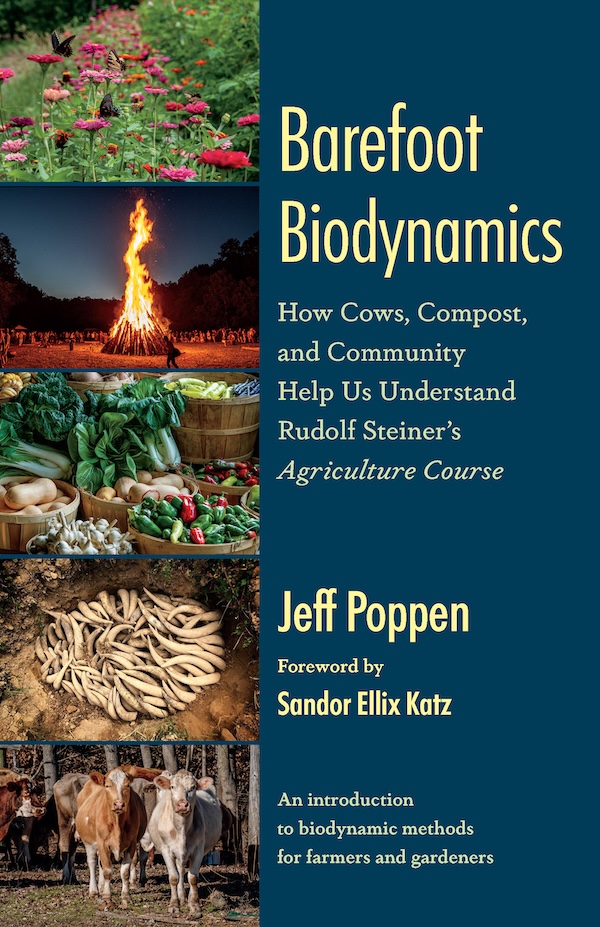
By Jeff Poppen
Chelsea Green, 2024
I first met Jeff Poppen in 2019 at the National Biodynamic Association Conference in Lake George, New York. Having read Jeff’s previous books, but never having experienced his teaching, I wasn’t exactly sure what to expect — apart from his being a barefoot farmer with decades of biodynamic experience under his belt. During his 90-minute presentation, I learned more about making and using biodynamic preparations than I had in my previous decade of researching, collaborating with others, and working directly with preparations.
Jeff’s style of teaching — a mixture of storytelling and practical guidance, with a bit of magic carefully blended in — is reflected in his writing. All too often biodynamic teachers and farmers get lost in either the mysticism behind the preparations, their spiritual connections, or sticking dogmatically to the guidance that Rudolf Steiner laid out in “Agriculture Course: The Birth of The Biodynamic Method.” Jeff, in “Barefoot Biodynamics,” relates the depth and beauty of biodynamic farming without losing its esoteric underpinnings, or the reader, in the process. It is a book of practical guidance intertwined with enough mysticism and spirituality to reinforce that biodynamics is more than just “the doing” of something different than what you may have been doing before. Sound agronomic practices are the foundation of biodynamic agriculture to be sure, but the use of the preparations and some cosmic know-how make it an entirely different universe.
Jeff’s story starts with him growing up on a farm with parents that subscribed to Helen and Scott Nearing’s “Good Life.” He moved to Tennessee to start his own farm in 1974 and had already been an organic farmer with a few years under his belt by the time he read “Agriculture Course.” Jeff was impressed not only by Steiner’s approach but also by what he witnessed on neighboring organic and biodynamic farms. His new book details the importance of cattle to his farm, lessons that he and his wife Debby learn over the years, and some of the more obscure biodynamic practices, such as ashing and peppering.
Jeff explains Steiner’s “Agriculture Course” in a manner that makes it understandable to the beginner yet meaningful to the practiced biodynamic farmer. In a presentation style he explains the four elements of earth, water, air, and fire as they relate to root, leaf, flower, and fruit/seed stages of plant growth. Readers begin to understand carbon, oxygen, nitrogen, sulfur, and hydrogen not just in their scientific sense but also the cosmic connections between them and how they relate to a science that many of us were taught over the years. Yet, the biodynamic preparations are described not in a pedantic “how-to” style but rather with a digestible explanation of the substances, the sheaths, and the forces as they relate not just to the esoteric but to the practical side of farming. In doing so the author allows one to first “look” and then “see” the full spectrum of biodynamic components in the light they are meant to be, and to relate them back to practical farming skills such as tillage and composting.
Far from a practical “how-to” book, “Barefoot Biodynamics” opens the door for anyone looking for a “next level” farming, food production, and land conservation life.
– Mike Biltonen
This review was originally published in the winter 2025-2026 issue of The Maine Organic Farmer & Gardener.